Thursday, November 19, 2009

2 Nephi - Chapter 12


I love all of our temples.  My own local one, in Vernal, Utah is very special to me.  But, there is something about the Salt Lake Temple and it's fulfillment of Isaiah's prophecy that makes it extra special.  It has a majesty, history and uniqueness that is unrivaled as yet.  A am so thankful that the Lord has provided a way to buffer it from encroaching Babylon, by allowing the Church to acquire and beautifully develop attractive, useful and quiet properties surrounding this sacred place.  Of course one of this Temple's great functions is to host the meetings of the First Presidency and the Quorum of the Twelve.  Marvelous revelation continues to come forth from within those hallowed walls.

If you have not seen the movie The Mountain of the Lord, about the creation of this beautiful edifice, you simply must.  I've embedded part one of eight right here so you can.


One has only to travel on America's highways to see the fulfillment of Isaiah's observation of there being no end to their chariots; or to drive our neighborhoods to observe no end to their treasures.

It has to be obvious then, that what he observed about the day of the Lord, must also come to pass and that for the wicked it shall indeed be dreadful. Hopefully, for me that day will not be dreadful, but great! I think the difference lies not in whether or not we have cars and possessions but in how we see them. Do we claim our stuff as our own? Or do we see those things as stewardships from God with which we might accomplish His mighty work in building Zion. Same stuff, big difference.

Wednesday, November 18, 2009

2 Nephi - Chapter 11


I love how Nephi emphasizes that all things given of God typify of Christ.  The Book of Mormon cites a few examples, the brazen serpent Moses placed upon a pole for instance.  The most poignant, for me, however, was the one James L. Ferrell pointed out in his wonderful book The Peacegiver.  If you've read it, you'll know whereof I speak.  If not I'd love to invite you read the 25th Chapter of 1 Samuel and see if you can see it for yourself.  I don't think I would have seen it.  Clearly the one time I had previously read that chapter, I totally missed how the story was a brilliant type of Christ.  Ferrell's examination of one chapter has inspired me to watch carefully for other instances of such precious gifts from God that I may, in fact probably, have missed.

Then, again, Nephi encourages us to liken the scriptures unto ourselves.  This too is a marvelous method for personal discovery and revelation as we read the scriptures.  Some of the war chapters have been so personally inspiring for me.  I'll share some of that when we get there.  But suffice it for me to say that there are often multiple meanings and precious gifts prepared by our Father for those of us willing to ask the two great study questions Nephi suggests:  How does this typify or testify of Christ?  How can I liken this story or doctrine to myself?

I served my Mission in a largely Catholic country.  The people had been taught that only the Priest should interpret the scriptures.  How wonderful it is that God trusts us enough to invite us to seek his messages; personal messages that pertain, perhaps only to us individually, which can and are discovered when seeking earnestly and by pondering in companionship with the Spirit.

Tuesday, November 17, 2009

2 Nephi - Chapter 10


I wonder why the name of Christ was not revealed until Jacob.  Apparently it was not found in the Brass Plates of Laban or revealed to Nephi or Lehi.  Perhaps Heavenly Father wants us to notice Jacob as a truly great prophet in the hope that we will pay special attention to his words.  It is also interesting that Jacob becomes the one who here, shares and then interprets the words of Isaiah.  Nephi has indicated that he is able to understand Isaiah's words because he is familiar with the culture of the Jews.  Jacob was born in the wilderness and knew little about Jerusalem, at least first hand.  Clearly he was a good student of his brother, his father and the Spirit, to be qualified to make such interpretations for us.  Perhaps we can learn from Jacob that Isaiah can indeed be understood by we who also are far removed from Jerusalem.

I can't see this specifically mentioned in The Book of Mormon, but is seems to me that when comforting words are given to the Nephites about the eventual restoration of their seed to the knowledge of the truth, it would be a hollow comfort if it only included their far distant posterity.  What about all the ones lost in hell in between their present and the far distant conversion of their children at the hands of the Gentiles?  Surely, they understood that upon the conversion of their descendants in the latter days that those recovered family members would commence the work of redemption for their dead and restore the links of eternity to their entire family.

I have a dear friend who is a Baptist minister.  We were once employed together in a job that required we work together closely.  Both of us were quite anxious about the situation at first.  The reasons are obvious.  What a surprise it was to each of us when we became fast friends.  We discussed religion often.  In an early conversation he asked if I had been born again.  I replied that I had.  You could have knocked him over with a feather.  Upon his recovery from the shock he told me, "You are the first Mormon I ever met who ever mentioned that, let alone claimed it!"

Perhaps many of his Mormon friends didn't claim to be born again because they had not.  Many more, I suspect are just uncomfortable mentioning it.  It seems such a Protestant phrase that we dismiss it along with grace.  The fact is, however, that we must be born again and we must receive grace sufficient to qualify us for our rebirth.  Looking back from that startling conversation, I thought of my rebirth and the sacred gift of grace.  I thought of reading Steven Robinson's book Believing Christ and the paradigm shift that ensued.  I thought of my impossible recovery from addiction.  I thought of the unspeakable blessing it is to have Christ rescue me from the bonds of iniquity.  So, I really appreciate Jacob's admonition when he says:
 "Wherefore, my beloved brethren, reconcile yourselves to the will of God, and not to the will of the devil and the flesh; and remember, after ye are reconciled unto God, that it is only in and through the grace of God that ye are saved."

Monday, November 16, 2009

2 Nephi - Chapter 9


I will never forget how startled I was, when, listening to Conference, I heard Elder Dallin H. Oaks define Hell as Spirit Prison - period.  I had, prior notions that the Outer Darkness to which Lucifer must spend eternity was Hell.  That is a very important distinction and Chapter 9 is wonderful at explaining why.  The Atonement was wrought by the Savior for the purpose of delivering us from Hell.  Hell, therefore, is not a permanent state determined to last forever.  All but a very few will one day emerge from that place, or as I prefer to see it, state.

Recently I had an interview with a young lady in the Detention Center.  She asked me a serious question from her heart, "Am I going to Hell?"  In deepest love and sympathy I asked her, "Sweet child, aren't you there already?"  She wept and nodded, full of grief at a state of being that had long brought suffering to her life.  I personally don't think Hell is geographically separate from Paradise.  My experience here on earth leads me to believe that Hell is primarily a state of mind and heart, not defined by boundaries, but by feelings and attitudes.  Hell can be pretty bad here, but must be worse after we leave mortality, because there we will be stripped of the myriad ways in which we self medicate.  The state of being which creates the pains of Hell exists on both sides of the veil, but the body only exists here.  We can drug, feed, satiate, sleep away, distract and otherwise anesthetise our bodies; but lacking bodies, we will be left to endure the agony of our circumstances unrelieved of full pain and anguish.

There is only one real, bonafide remedy for such pain and that is to give it to Christ.  A principle which applies there just as well as here.  I loved it when I heard John Lund describe Hell as God's Alternative High School.  "...death and hell must deliver up their dead (both physical and spiritual)", Jacob plainly declares.  It is the Savior's intention to empty the place, or in other words, to heal us all from the wounds of mortality.  A few years ago the Temple President quoted an early Church leader (wish someone could help me find the reference) saying some thing close to, "the vast majority of the people, for whose names we are laboring, are accepting the work we do here in the Temple."  What a glorious thing to know.

People are crossing from Prison to Paradise all the time.  I suspect there will come a time when I'll be occupied with assisting persons in Hell to make that transition, by teaching them the Gospel.  In a very real way, I am presently occupied at the Detention Center doing the same thing.  I have a notion that if someone is required to linger in Spirit Prison to teach the word, I would like it to be me.  If given the chance, I would choose to tarry until the last person has made the glorious discovery of redemption.

Sunday, November 15, 2009

2 Nephi - Chapter 8


There may be no more comforting chapter in all of scripture, in terms of promises to the Saints of the Latter-days.  Here God, himself promises to care for his people.  He asks us to remember who we are and where we come from.  He reminds us that we are His and that He will protect us.  Then He begs us to get up from the filth of our lives and be loosed from the bands of captivity.

Now, you may think me a bit provincial in this, but I think an enormous part of what God is calling for is for us to shed the bonds of addiction.  If you listen carefully to General Conference, you will note that addiction is a frequent focus of emphasis by the Prophet and the 12.  There is a reason for this.  Addiction is rampant in the church.  For every brother or sister I see attending the LDS Addiction Recovery Program, I am aware of several, who are addicted, but who do not attend.  Pride, fear, and ignorance keep many more away that the few who humble themselves sufficiently to seek help. 

Addiction in its many forms is one of Satan's greatest weapons and with it he is currently sweeping the earth.  As we "hearken" and "follow after righteousness;" as we remember "Lord thy maker, that hath stretched forth the heavens;" as we rely on He who drank the "dregs of the cup of trembling wrung out;" we will surely rise above the chains of Satan's captivity.

This chapter seems to speak to me and so many others who are "afflicted, and drunken, and not (merely) with wine."  It is a call for us to shake off the chains with which we are bound and put on the strength of the Master.

Saturday, November 14, 2009

2 Nephi - Chapter 7


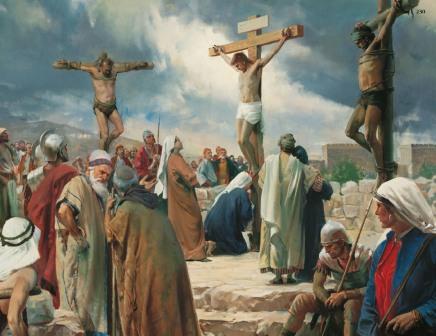
Isaiah describes the Savior's suffering in sufficient detail to persuade me that he actually witnessed that sacrifice which would happen so much later.  Explaining that the distance we feel or discover between ourselves and the Master is one of our creation not His.  We move away from Christ.  He never moves away from us.  Like Esau, we so willingly sell ourselves for things of naught.  What a blessing it is that after living a perfect life, after suffering and completing a perfect sacrifice, after the most majestic triumph of all time; though we so readily depart from Him, His hand is stretched out still - to recover us.