Lots of interesting lessons on economics in this chapter. The robbers couldn't imagine a time when resources would not sustain them. They expected there would always be plenty for the taking. Our government officials seem to have the same mentality. While we don't call them robbers, they seem to have the same motives, to take from the producers and distribute to those who've done no producing. Already we're beginning to see that it won't sustain itself any more than it did for the Gadiantons. I suppose there will come a time, when like in Ayn Rand's novel Atlas Shrugged, those upon whose backs the current system rides will have had enough and withdraw from the system, causing it to collapse. I think we are increasingly living a Plutocracy that is operated quite similarly to the Gadianton system. Neither system is just. Neither system can long survive.
The Nephites survived this mess because they chose leaders who were prophets and then followed them. We may do the same. How many of us though, will say, "But I want my share of the pie and join the wrong team?

Tuesday, August 31, 2010
Monday, August 30, 2010
3 Nephi - Chapter 3


I love Lachoneus' inspired strategy. It is tempting to do the same thing today. Imagine what would happen if the United States completely withdrew from the rest of the world. Imagine if all the money and lives we spend abroad were brought back home and we simply defended our borders and lived here, isolated in our own land. Surely, our enemies would we caught in a wilderness of their own making and find themselves in a world of hurt.
Now I'm not advocating that we do that. Not yet at least. There is much good that is being done abroad that helps innocent, deserving people. People whose lives would be devastated by the departure of our presence and influence. Are there negative consequences to our present policy? Of course. But I think the good far outweighs the bad.
I know of families who are presently using Lachoneus' tactics. They've withdrawn from the world and from the influence of their enemies by home schooling their children. I have two very fine, very good friends who did this and who now, publicly lament their choice. They both have come to believe that we are to "be in the world, but not of it." They both believe now, that they cheated their children by withdrawing them from the world. I think they also cheated the world. Now, I suppose there a ways to home school without withdrawing from the world, but these two brethren, didn't find such a way.
I believe there may come a time when we, like the Nephites, are called upon, even forced to collectively withdraw from the world for our safety. But that time is not yet. We must mix with the rest in order to be the leaven of the loaf. If and when we withdraw, it will most certainly mean the destruction of those not invited to join us. We Latter-day Saints are the children of Abraham and it is ordained that through us and our influence and our presence, that the balance of God's children may be blessed. If we, for our own safety and selfish concerns, choose to withdraw from the world, it will be to our condemnation. We are called to bring light into dark places. If we do, the light will dispel the darkness.
Let us follow the prophet. He has invited us to go into ALL the world and share the light of the gospel. If the time ever comes that we must do otherwise; we'll also have a prophet then. One who will, like Lachoneus, give us appropriate counsel for our time.
3 Nephi - Chapter 2
This chapter describes something I love about Church membership, or the fellowship of the Saints. Along with that fellowship comes a true brotherhood and sisterhood. Our differences dissolve and we become one. This is not to say we lost our individuality. It is not to say that we become homogenized. It just that with one heart we love and are loved and stand united in our love for the Savior.
The big distinctions in our relationships with others have nothing to do with our country of origin. It is not a matter of high birth or skin color. The biggest distinction lies in whether or not we choose the Savior as our guide.
Ultimately, when the line gets drawn in the sand of eternity the distinction will be who stands on the Lord's side. Who?
The big distinctions in our relationships with others have nothing to do with our country of origin. It is not a matter of high birth or skin color. The biggest distinction lies in whether or not we choose the Savior as our guide.
Ultimately, when the line gets drawn in the sand of eternity the distinction will be who stands on the Lord's side. Who?
Sunday, August 29, 2010
3 Nephi - Chapter 2
This chapter describes something I love about Church membership, or the fellowship of the Saints. Along with that fellowship comes a true brotherhood and sisterhood. Our differences dissolve and we become one. This is not to say we lose our individuality. It is not to say that we become homogenized. It just that with one heart we love and are loved and stand united in our love for the Savior.
The big distinctions in our relationships with others have nothing to do with our country of origin. It is not a matter of high birth or skin color. The biggest distinction lies in whether or not we choose the Savior as our guide.
Ultimately, when the line gets drawn in the sand of eternity the distinction will be who stands on the Lord's side. Who?
The big distinctions in our relationships with others have nothing to do with our country of origin. It is not a matter of high birth or skin color. The biggest distinction lies in whether or not we choose the Savior as our guide.
Ultimately, when the line gets drawn in the sand of eternity the distinction will be who stands on the Lord's side. Who?
Saturday, August 28, 2010
3 Nephi - Chapter 1

Friday, August 27, 2010
Helaman - Chapter 16
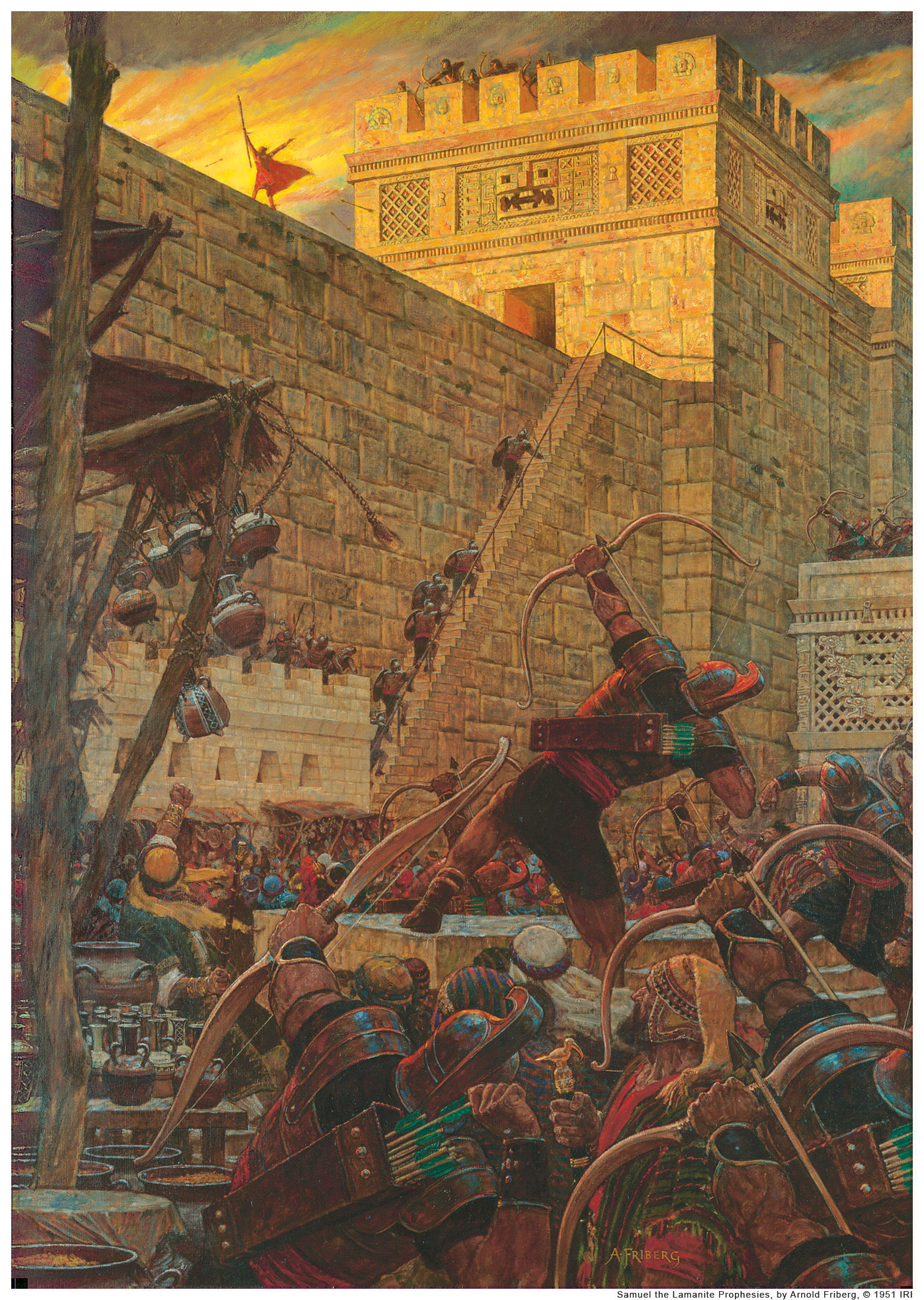
Samuel was a wake up call for some. Might he be a wake up call for us? He could. We could choose today to respond to his call to repentance. Why would we wait? We can make excuses. I'm sure the Nephites did. "I'm not listening to no Lamanite!"
15 Nevertheless, the people began to harden their hearts, all save it were the most believing part of them, both of the Nephites and also of the Lamanites, and began to depend upon their own strength and upon their own wisdom,
Interesting that we harden our own hearts. Soft hearts depend upon God. Hard and hardened heart depend upon their own strength. How much history do we have to read before we get this. How difficult is it to observe that depending upon one's own strength always ends in disaster. We may delude ourselves into thinking it is otherwise, but it the end, everyone discovers the truth. Hard hearts learn the hard way.
Subscribe to:
Posts (Atom)